
Team Details
- Yuta ike : Engineer, designer and planner. University student.
Description of Project
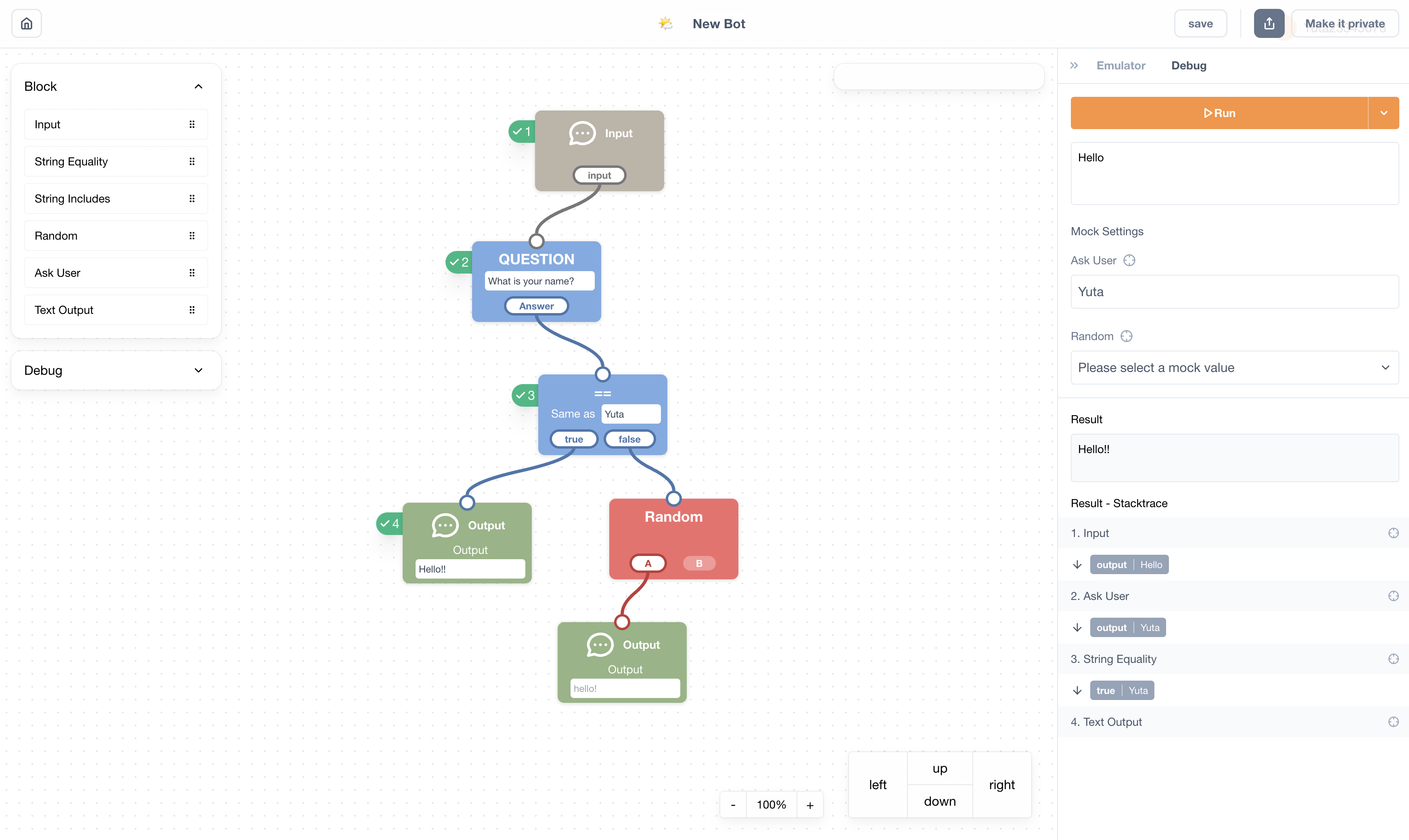
This project is a no-code tool that allows children to create chatbots in a fun way. When it comes to educational no-code tools, Scratch and Minecraft are well-known. While these tools are fantastic, they are both game-based, making it difficult to create real-world useful products. That's why I developed a no-code tool specifically designed for elementary school students. I chose chatbots as the subject because logic is simple and they are a familiar tool for chatting.
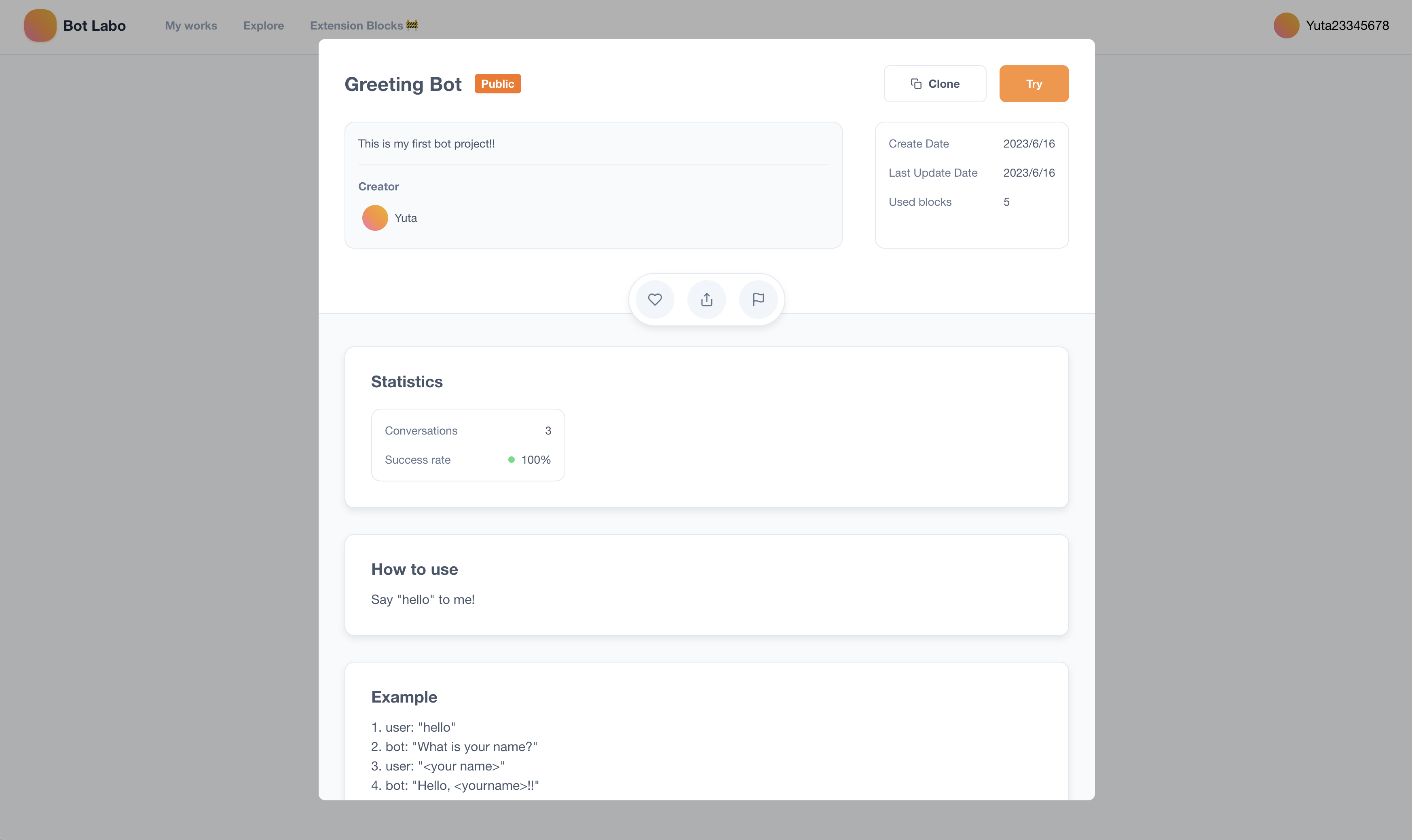
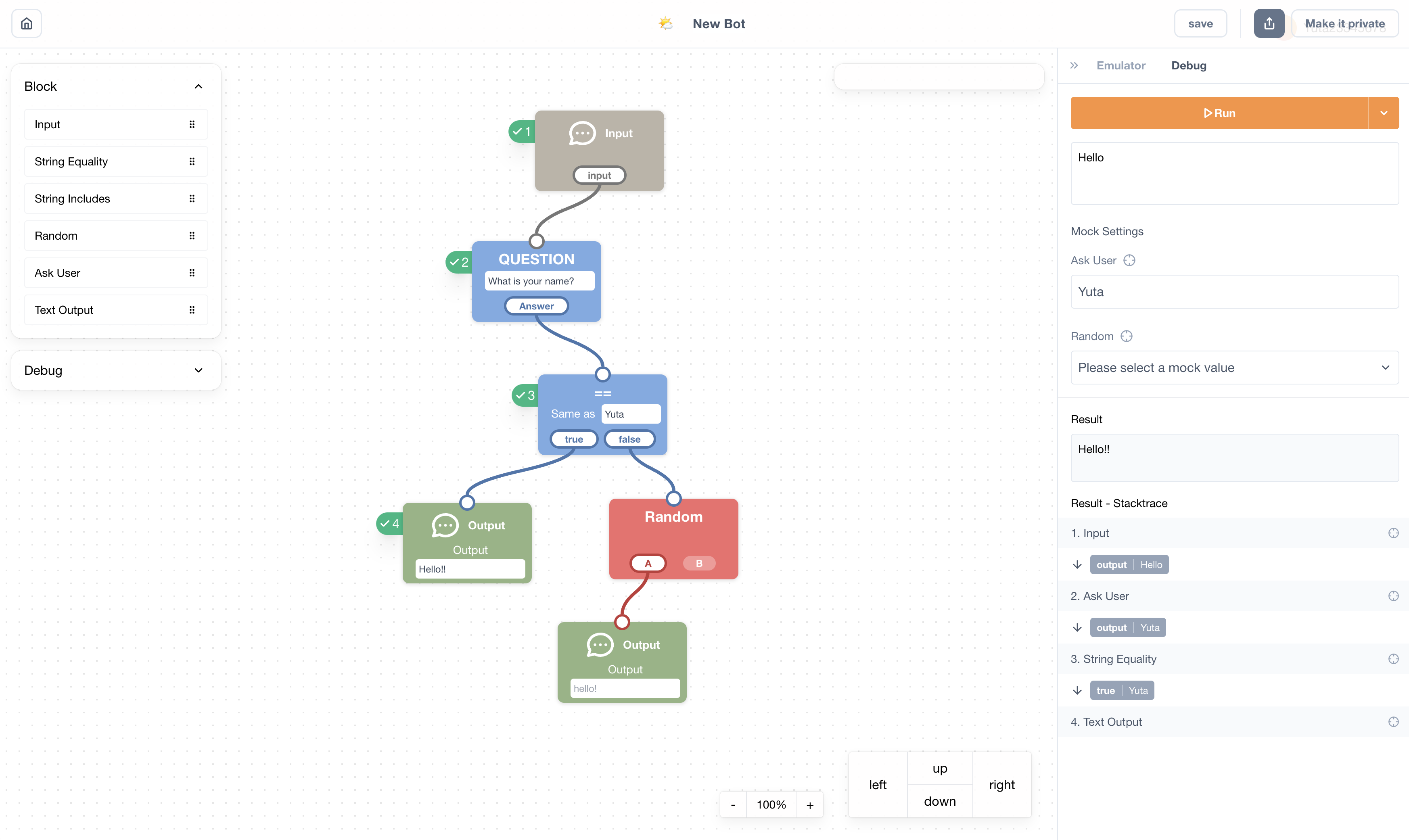
The test can set mock values. Processes that rely on probabilities ("Random" nodes) or nodes that interact with the outside world ("Ask User" nodes) can be debugged efficiently by providing mock values.
The custom-built no-code editor prioritizes colorful visuals, simplicity, and easy debugging. You can describe the logic like a flowchart, starting from input nodes and connecting them to output nodes. Once you've finished, you can even test it using an emulator.
By sharing the link, you can also have your friends use it. Although I couldn't complete it within this period, I am working on integrating it with existing chat services like Discord, LINE, Slack, and more. The programs created by children have the potential to truly enhance the daily lives of their close family and friends, making them more convenient!
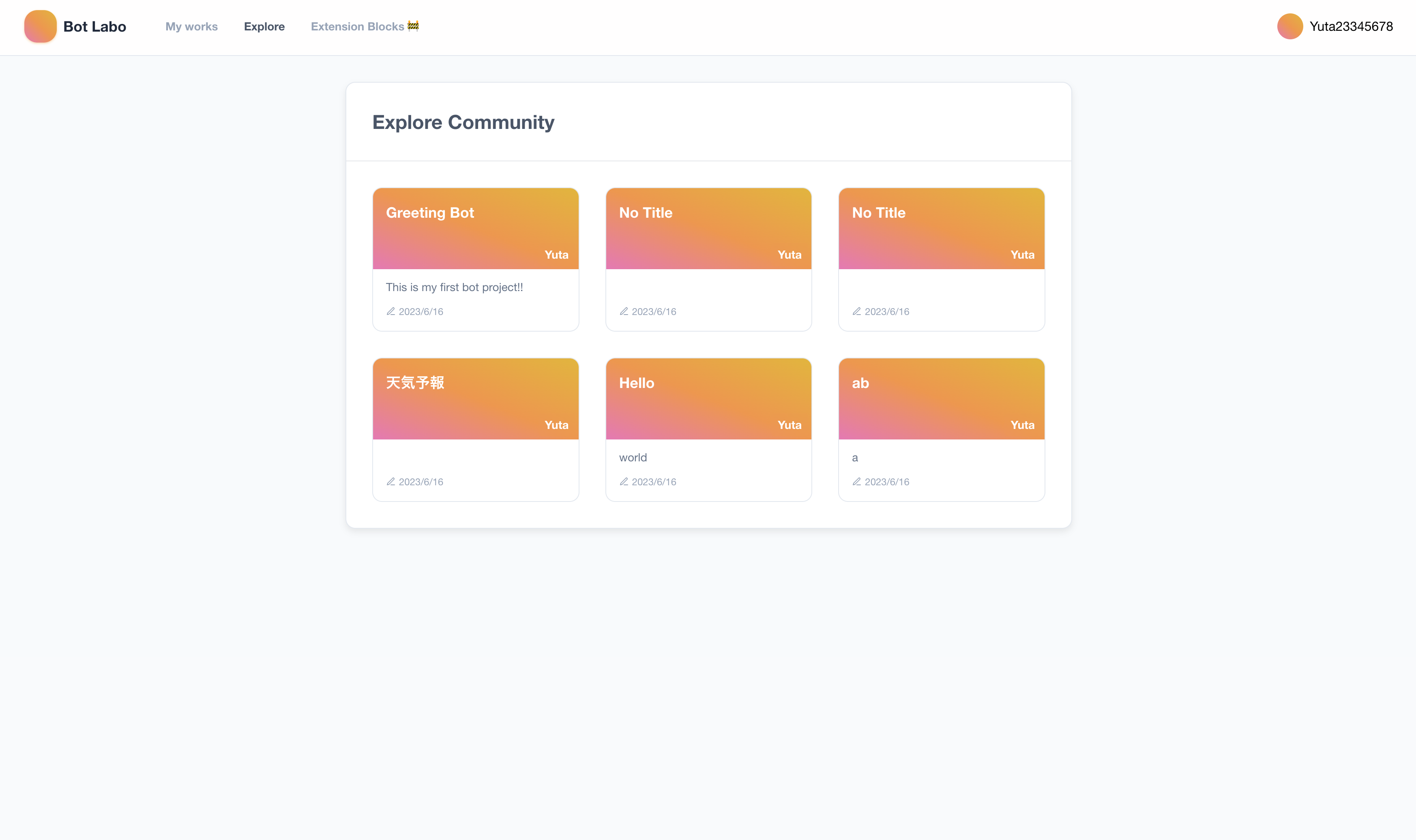
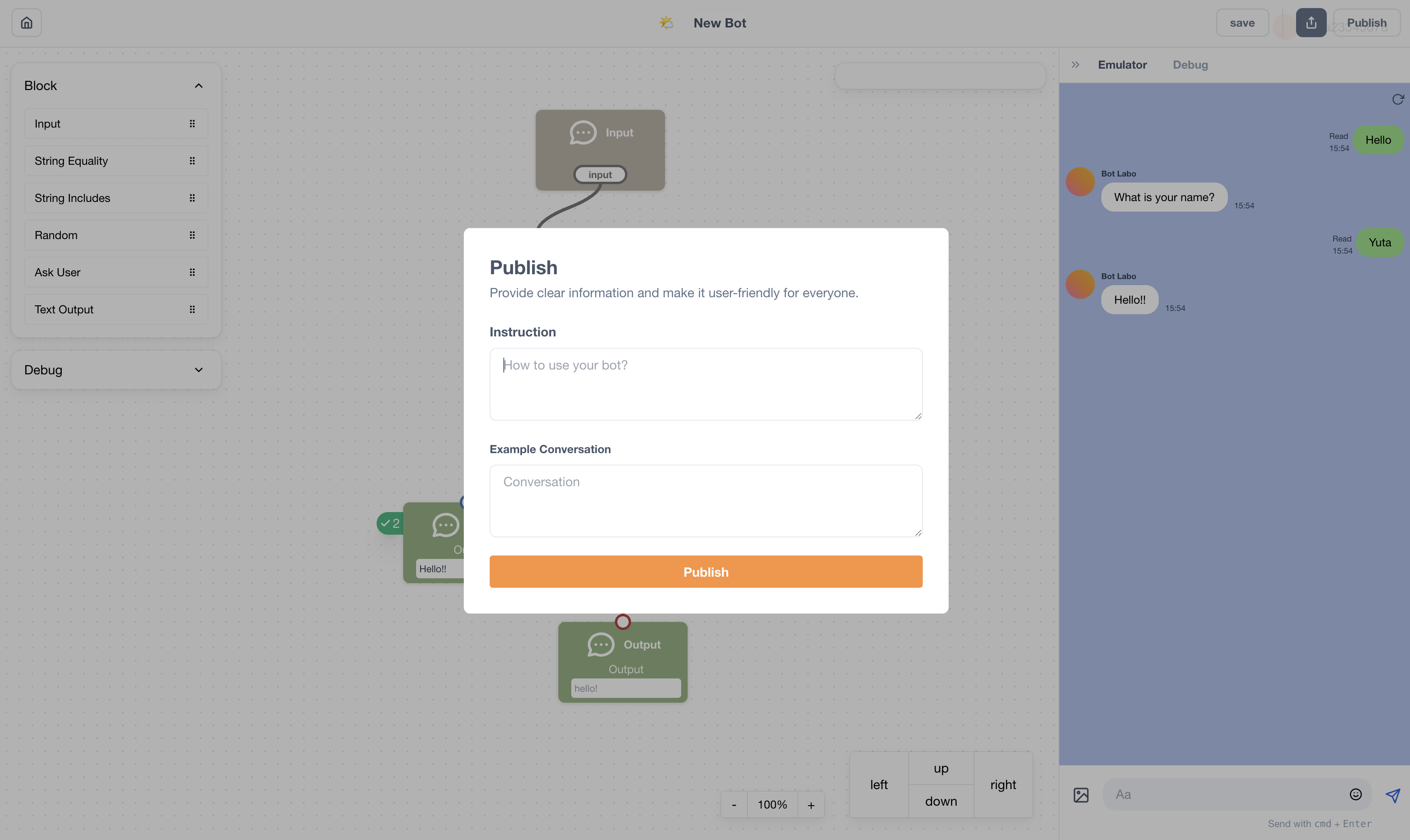
We have implemented a publishing feature within the service, allowing others to play with and even clone and modify bots created by different people. We hope this fosters interaction and collaboration among developers.
Tech Stack
TypeScript
Next.js
Tailwind.css
Radix UI
Recoil
SWR
Appwrite (database, authentication, (functions))
Challenges We Faced
UI / UX
I sometimes had trouble with the design. The editor screen in particular had a lot of content to display, such as mocks and stack traces, making it difficult to design the information. Therefore, we conducted interviews with people around us and aimed to create a design that was easier to understand and had less cognitive load. Furthermore, we learned that children get bored easily, so we devised a way to keep them from getting bored.
Although I couldn't implement it during this period, I had plans to integrate the tool with popular chat platforms like Discord or LINE, which are commonly used. I spent about two full days exploring the integration with Discord using Appwrite functions, but I couldn't realize it due to some bugs. However, I gained valuable insights, and I'm planning to give it another try.
Future Work
Integration with Chat Services (Discord, LINE, Slack, etc.)
Although I couldn't complete the integration during this period, I had plans to integrate the tool with popular chat platforms like Discord, LINE, Slack, and others. I dedicated about two full days to exploring integration with Discord using Appwrite functions, but I encountered some bugs that prevented me from realizing it. However, I gained valuable insights from the experience, and I'm planning to give it another try.
Integration with AI
One of the strengths of this product is that the flowchart-style programs are represented in JSON format. By leveraging this, we can achieve "Text to JSON (program)" conversion, making it easier to create applications. Since the focus is on education, this feature can be utilized to seek assistance with difficult parts or to create sample projects.
Function System
Currently, in Bot Labo, programs consist of a single flowchart. While this simplicity is appreciated, it can result in spaghetti code when programs become more complex. To address this, I'm planning to support function nodes that allow the extraction of a block of processing into a separate flowchart.
Community Nodes
Bot Labo currently supports only a few types of nodes due to limited developer resources. In the future, I intend to enable the import and export of function programs created using the aforementioned function system. This will allow users to freely share and utilize functions, even for complex processes that may be challenging to build from scratch. (The function system was created to facilitate this!)
Third-party nodes
I plan to add nodes that integrate with external APIs. For example, it would be great to have the ability to query ChatGPT! If you're an engineer, you can run your own program on a server and query it from the nodes.
Public Code Repo
https://github.com/yuta-ike/line-bot-maker-new
Demo Link
Comments
Join the discussionNo comments yet. Be the first to comment.